
PMAD — Pool-based Memory Allocator
A slab allocator written in C that delivers O(1) allocation and deallocation with zero fragmentation and zero system calls at runtime. Every allocation the daemon makes — task envelopes, wire buffers, worker registration slots — comes out of PMAD. Fragmentation is 0 % by design: every block is pre-sized to a declared class, so there is no splitting, no coalescing, and no wasted space.
PMAD pre-allocates a contiguous pool of memory with a single mmap call at startup, then partitions it into user-defined size classes. Standard allocators (ptmalloc, jemalloc v5.3, tcmalloc v2026) optimise for average-case throughput — PMAD optimises for worst-case determinism and predictable latency budgets.
| Domain | Why PMAD fits |
|---|---|
| Real-time systems | Guaranteed O(1) response — no lock contention, no syscalls at runtime |
| Embedded / RTOS | Minimal footprint, no heap fragmentation, fully configurable memory layout |
| Game engines | Predictable frame-time budgets with zero allocation jitter |
| High-frequency trading | Nanosecond-class allocation latency under sustained throughput |
Architecture
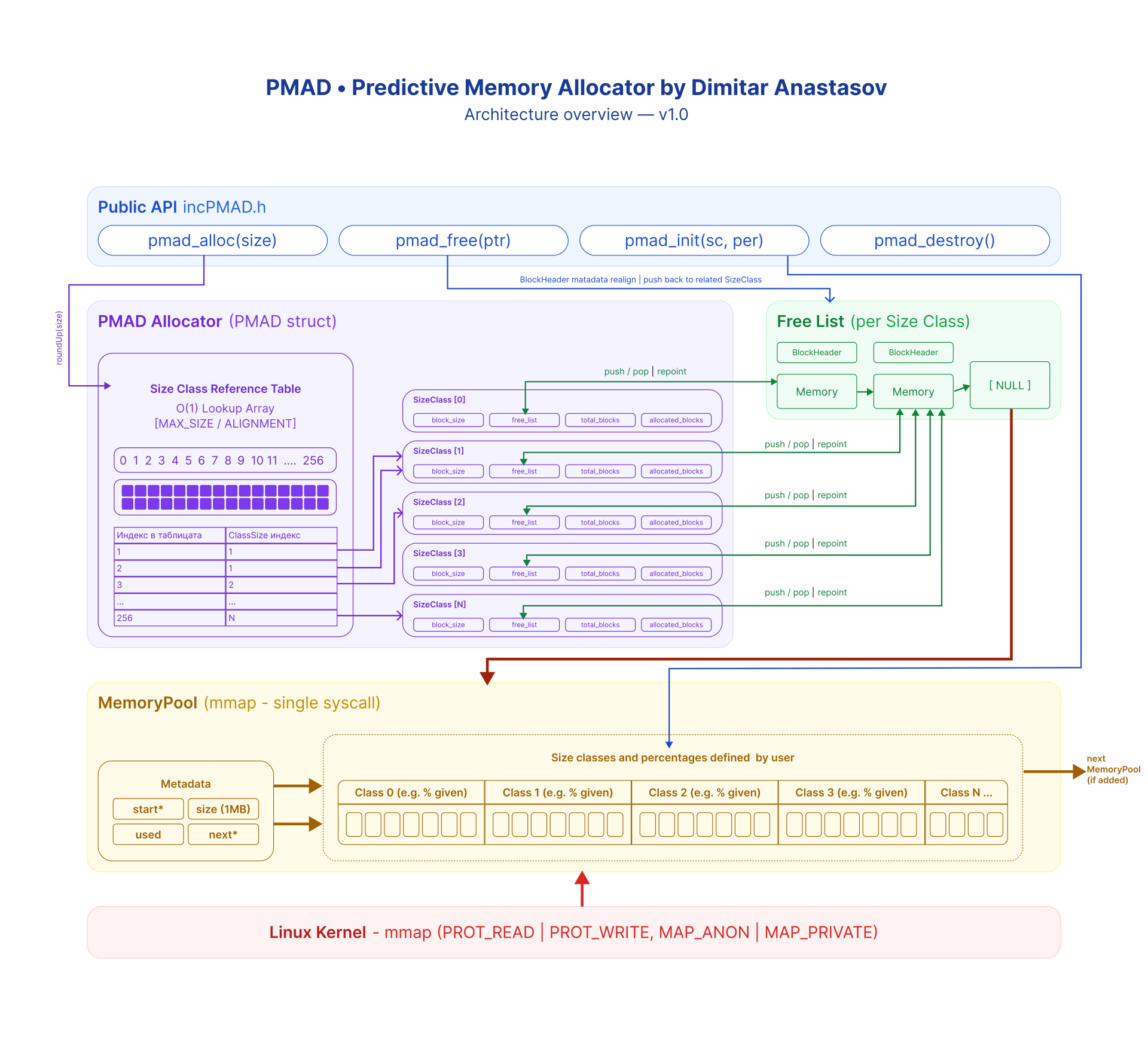
Every allocation is a single lookup-table index followed by a free-list pop. Every deallocation is a free-list push keyed by the block’s own header. Both operations have no conditional branch paths — the fast path is the only path.
- Public API
- The thin facade in
incPMAD.h—pmad_init,pmad_alloc,pmad_free,pmad_destroy,pmad_get_stats. This is the entire contract the daemon consumes. As of v1.0.3 every entry point takes an explicitPMAD*— there is no process-global allocator instance anymore, which is what lets each daemon shard eventually own its own pool. - Hard limits
MAX_PMAD_CLASSESis 64 (up from 32) andMAX_SIZE_OF_SIZE_CLASSis 1024 bytes (down from 4096) as of v1.0.3. Allocations above 1024 bytes are rejected outright — there is no fallback to a general-purpose heap.- Failure reporting
pmad_allocused to return a barevoid*—NULLmeant “something went wrong” with no way to tell what. It now returns aPmadStatuswith the pointer as an out-param, and five codes distinguish causes:PMAD_ERR_TOO_MANY_SIZE_CLASSES,PMAD_ERR_DEALLOCATING_MMAP,PMAD_ERR_ALLOCATION_OF_0_NOT_ALLOWED,PMAD_ERR_ALLOCATION_TOO_BIG, andPMAD_ERR_OUT_OF_MEMORY.- Size Class Table
- A flat array
[MAX_SIZE / ALIGNMENT]maps a requested byte-count directly to the correct size-class descriptor — an O(1) table lookup, no branches. - Free Lists
- Each size class owns a singly-linked intrusive free list. A pop is a pointer dereference; a push is a pointer swap. No atomics on the fast path — the daemon serialises through its own router, so locks are structurally unnecessary.
- Memory Pool
- One
mmapregion split into contiguous runs of blocks, one run per class, sized by the user percentages. Each block carries a 16-byteBlockHeader(nextpointer + class ID) so deallocations need no external metadata.
pool->usedused to be initialised to zero and never moved — the number was meaningless. As of v1.0.3 it’s maintained on every path: seeded with sizeof(MemoryPool) plus the size-class array at init, plus every BlockHeader at split, then adjusted on every alloc and free. This is what makes quicx status’s memory numbers trustworthy.Benchmarks
These are allocator micro-benchmarks, measured separately from the daemon on Apple Silicon (-O3 -march=native) with the harness in the PMAD repository — not the end-to-end task-queue numbers. For those, see Benchmarks. Full source and reproduction instructions are on github.com/anastassow/PMAD.
| Metric | Value |
|---|---|
| P50 allocation latency | 2.59 ns |
| P99.9 allocation latency | 6.50 ns |
| Latency vs block size | Flat — 2.59 ns P50 from 16B to 1024B (O(1) guarantee, demonstrated) |
| Peak throughput | 748.9 Mops/s @ 16B · 690.6 Mops/s @ 64B |
| Worst-case under churn (1024B) | ~40 µs (system allocator: 6.95 ms) |
| Fragmentation | 0 % |
| Runtime syscalls | Zero |
| Correctness | 19/19 tests pass |
Reference configurations
| Profile | Size classes (B) | Split (%) | Suitability |
|---|---|---|---|
| Max throughput | {16} | 100 | Small-object velocity |
| Min overhead | {1024} | 100 | Bulk data density |
| Balanced | {64, 256, 1024} | 60 / 30 / 10 | Mixed workloads |
| Latency-optimised | {32, 128} | 80 / 20 | Critical signalling |
| HFT / network | {32, 128, 512, …} | 60 / 20 / … | L3 packet processing |
| Embedded / RTOS | {8, 16, 32, …} | 30 / 30 / … | Deterministic control |
pmad_alloc is as fast as your first.Tear-down
A single munmap returns the entire pool to the OS in O(1) — there are no individual blocks to walk, no fragmented regions to compact. Shutdown is symmetric with startup: one syscall in, one syscall out.